· Legal AI Workflows · 3 min read
Audit Trails for Legal AI Operations
What law firms should reconstruct when an AI workflow reads information, proposes a decision, or attempts an external action.
Technical architecture commentary — not legal advice. This article describes design questions and test criteria, not deployed Nesthing features or compliance conclusions. Record-keeping requirements require firm-specific professional review.
When an AI-assisted workflow fails, the first question is rarely “Which model was used?” The useful questions are: What information entered the workflow? Which rule applied? What output was produced? Who reviewed it? What action was attempted? What stopped or allowed that action?
An audit trail should make those questions answerable without relying on memory or scattered screenshots. MinLaw identifies traceable input/output logs, version histories, and approval trails as relevant auditability measures (MinLaw, 2026).
Record events, not just transcripts
A chat transcript may omit system changes, retrieved documents, tool calls, retries, approvals, and human edits. A workflow event record can capture each material transition separately.
Depending on the approved design, an event may include:
- run and matter identifiers;
- actor type and authorised role;
- workflow and instruction version;
- source references or hashes;
- requested and completed action;
- timestamp and status;
- approval or rejection reference; and
- exception code and resolution.
Sensitive content should not be copied into logs by default. The record can reference protected evidence while applying the firm’s access and retention rules.
Treat exceptions as designed states
Exceptions are expected operating conditions, not merely software errors. Examples include missing client information, conflicting matter identifiers, unsupported file types, low-quality scans, unavailable integrations, ambiguous instructions, expired approval, or a permissions mismatch.
Each exception class needs an owner, allowed resolution, and maximum permitted next action. If the workflow cannot establish authority, it should stop or route to review. MinLaw’s adoption framework recommends incident procedures covering triage, rollback, mitigation, notification, and vendor escalation.
Preserve the difference between attempt and effect
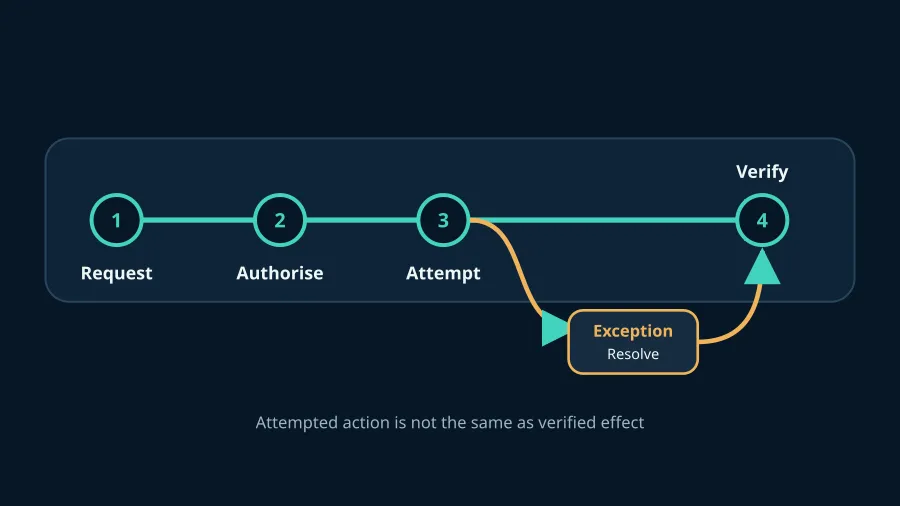
A tool call does not prove that a business action succeeded. The system should distinguish requested, authorised, attempted, completed, verified, failed, and reversed states.
For consequential actions, independent confirmation may be needed. For example, a workflow can verify whether a target record contains the expected change, rather than treating a successful API response as conclusive.
Make replay safe
Retries can create duplicate emails, records, or tasks. Idempotency keys, state checks, and explicit retry rules can reduce that engineering risk. A resumed run should know which steps are complete and which require renewed approval. NIST’s framework supports documented risk response, recovery, monitoring, and continual improvement across the system lifecycle (NIST AI RMF 1.0).
If a material input changes during recovery, the workflow should create a new reviewable version rather than quietly continuing under an old decision.
Build an operational review view
Raw logs are difficult for reviewers. A useful review view can present the source set, proposed output, material rules, approvals, exceptions, and final effect in chronological order. Access should follow approved roles and deployment configuration.
Test reconstructability
A pilot can select completed and failed runs and ask an independent reviewer to reconstruct them. Candidate tests include:
- identifying the source and output versions;
- confirming the authority for each gated action;
- locating every exception and resolution;
- distinguishing attempted from verified effects;
- demonstrating safe retry behaviour; and
- producing a minimal incident evidence package.
The objective is not to claim perfect visibility. It is to define what evidence the workflow must produce, validate it during a controlled pilot, and document any remaining gaps before wider use.
Related reading
- Evidence-first legal document review
- Model-agnostic legal AI workflow control
- Security and data boundaries
Evidence boundary
OWASP’s current GenAI guidance provides a technical risk reference for systems that handle sensitive information or exercise tool authority (OWASP Top 10 for LLM Applications 2026). It is not legal authority or proof that a specific implementation is secure.