· Legal AI Workflows · 4 min read
Evidence-First AI Document Review for Law Firms
A framework for separating extraction, review, approval, and evidence capture in AI-assisted legal document workflows.
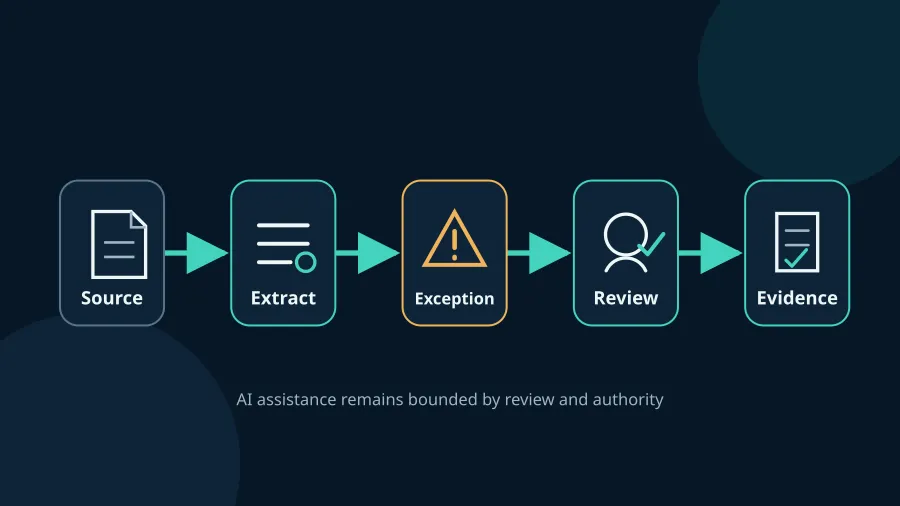
Technical architecture commentary — not legal advice. This article describes a conceptual workflow, not a statement about Nesthing’s deployed capabilities. Deployment scope, data handling, model routing, controls, and professional obligations require firm-specific review and written approval.
Legal document review is not one task. It is a sequence of intake, extraction, comparison, judgment, approval, and record keeping. Treating that sequence as a single AI prompt makes it difficult to determine what the system saw, what it changed, and who authorised the result.
A controlled design starts by splitting the work into observable stages. AI may assist with selected stages, but professional users remain responsible for sources, conclusions, and external actions. Singapore’s Ministry of Law recommends necessary and proportionate human oversight, while the Singapore Courts require court users to independently verify material submitted to court (MinLaw, 2026; Singapore Courts, 2024).
Start with a review contract
Before choosing a model or automation tool, define the review contract for the matter:
- which documents are in scope;
- which versions are authoritative;
- which fields or clauses should be extracted;
- which comparisons are mechanical and which require legal judgment;
- who may approve each output;
- where evidence and decisions must be retained; and
- what should happen when required information is missing.
This contract gives the workflow a deterministic boundary. It also prevents a useful-looking summary from silently becoming an approved legal conclusion.
Separate extraction from judgment
Extraction can produce a structured record containing a source document identifier, page or section reference, extracted text, and confidence or exception flag. The next stage can compare those records against an approved checklist.
The workflow should not convert a missing clause into an automatic conclusion. It should create an exception for review. The same applies when documents conflict, scans are unreadable, or the source set is incomplete.
Make approval an explicit state
An approval gate is more than a button. MinLaw’s guide specifically identifies version histories, approval logs, and structured contract-approval workflows as auditability measures. A useful approval record can include:
- the output version reviewed;
- the evidence available at that time;
- the approver identity and role;
- the decision and timestamp;
- any conditions or required corrections; and
- the action permitted after approval.
Draft, reviewed, approved, rejected, and superseded should be distinct states. External sending, matter updates, or downstream system actions should remain blocked until the required state is reached.
Preserve an evidence chain
For each material output, the firm should be able to reconstruct the path from source to decision. That may require source hashes, workflow version, prompt or instruction version, model and configuration identifiers, generated output, human edits, and approval events.
The appropriate record depends on the firm’s policies and deployment design. The principle is simple: an output should not be easier to create than it is to explain.
Test failure paths before routine use
Happy-path demonstrations are not enough. MinLaw recommends defining a pilot scope, success measures, and user acceptance tests before broader implementation (MinLaw implementation checklist). A pilot should test duplicate files, inconsistent names, missing schedules, unreadable pages, unsupported file types, ambiguous clauses, unavailable integrations, and rejected approvals.
Success criteria should be agreed before the pilot. Examples include correct routing, complete evidence references, blocked unauthorised actions, recoverable failures, and a clear manual fallback. These are test criteria, not promised outcomes.
A practical pilot boundary
A controlled pilot can begin with one document class, one matter type, a limited user group, and no automatic external action. The firm can then decide whether the evidence quality, review effort, and exception rate justify a broader deployment.
The durable value is not autonomous document judgment. It is a workflow in which assistance remains bounded, approvals remain visible, and every consequential action can be traced to evidence and authority.
Related reading
- Human approval gates for legal AI workflows
- Audit trails and exception handling for legal AI operations
- Security and data boundaries
Evidence boundary
The cited guidance supports the governance principles above. It does not establish that any particular Nesthing control is implemented, effective, or compliant. Those conclusions require configuration-specific evidence and acceptance testing.