· Legal AI Workflows · 4 min read
Human Approval Gates in Legal AI Workflows
A framework for placing human review and approval gates in AI-assisted legal workflows while preserving lawyer decision authority.
Technical architecture commentary — not legal advice. This article describes a conceptual workflow, not a statement about Nesthing’s deployed capabilities. Professional users remain responsible for reviewing sources, conclusions, and external actions.
The central design question for a legal AI workflow is not simply what the model can do. It is where the workflow must stop and request authority.
An approval gate translates a firm’s responsibility structure into an operational control. It can prevent a draft, classification, or proposed action from being treated as final merely because it moved quickly through an automated system. This reflects MinLaw’s risk-based distinction between human-in-the-loop review for consequential legal work and supervisory monitoring for lower-risk, reversible tasks (MinLaw, 2026).
Classify actions by consequence
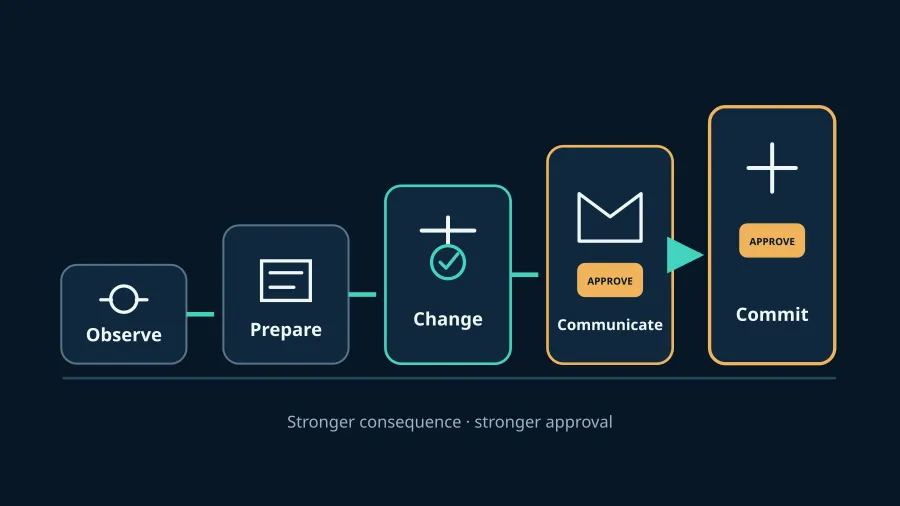
Start by grouping workflow actions according to their effect:
- Observe: read, extract, label, or summarise without changing a system of record.
- Prepare: create a draft, checklist, comparison, or proposed task.
- Change: update a matter record, alter permissions, or write to a business system.
- Communicate: send content to a client, counterparty, regulator, or third party.
- Commit: approve a filing, accept an obligation, authorise payment, or make another consequential decision.
The farther an action moves down this list, the stronger the case for explicit human approval and stronger evidence.
Define who can approve what
A generic “human in the loop” label is too vague. The workflow needs a role and authority model. NIST’s AI Risk Management Framework similarly calls for defined roles, responsibilities, and lines of communication across the AI lifecycle (NIST AI RMF 1.0). A reviewer may correct extracted data but lack authority to send a client communication. A supervising lawyer may approve a draft while a partner or designated manager controls matter opening or commercial exceptions.
The firm should define approval rules by workflow, matter type, risk level, and action. Unknown or conflicting conditions should route to a named exception owner rather than defaulting to approval.
Bind approval to a specific version
Approval should apply to the exact output reviewed. If the underlying document, generated draft, instruction set, or material evidence changes, the previous approval may no longer be valid.
A practical record can link the approval to an output version, source set, workflow version, approver, timestamp, and permitted next action. This helps prevent a late automated change from inheriting an earlier approval.
Use risk-based gates
Not every step needs the same friction. Low-consequence extraction may proceed to a review queue. A client-facing email, external filing, matter creation, or permission change may require positive approval. High-risk or ambiguous cases may require a second reviewer.
These thresholds should be selected by the firm and tested against real workflow examples. They should not be inferred from a generic model score alone.
Design for rejection and timeout
Approval workflows must handle “no,” “not enough information,” and no response. A rejection should stop downstream action and record the reason. A timeout should route to a manual queue rather than silently proceeding. Delegation and substitute approvers should follow documented rules.
Pilot with measurable controls
A controlled pilot can test whether the workflow enforces its intended controls. MinLaw recommends a defined pilot scope, success metrics, user acceptance testing, monitoring, and incident-response training before wider deployment. Candidate tests include whether the workflow:
- sends every gated action to an authorised role;
- blocks action until the required decision exists;
- preserves evidence and decision history;
- invalidates approvals when material inputs change;
- escalates exceptions and timeouts correctly; and
- provides a workable manual fallback.
These are acceptance-test candidates, not performance claims. Final criteria depend on the agreed deployment.
Powerful models can prepare more work, but they do not inherit professional authority. A well-designed control layer keeps that distinction explicit at every consequential step.
Related reading
Evidence boundary
The Singapore Courts state that responsibility for GenAI-assisted court material remains with the court user (Singapore Courts, 2024). This supports the professional-responsibility boundary, not a claim that the proposed workflow satisfies any firm’s obligations.