· Enterprise AI · 7 min read
Sovereign AI Engineering: Token-Efficient Local Code Auditing for Tech Startups
Discover how technology founders and enterprise software groups across Kuala Lumpur and Singapore utilize deterministic n8n pipelines, Claude Code SDKs, and local memory to scale terminal-based secure codebase audits.
🚀 For technology entrepreneurs, chief technology officers, and engineering directors driving high-growth SaaS platforms, fintech solutions, and AI automation tools across Malaysia and Singapore, protecting proprietary intellectual property is the firm’s ultimate existential boundary. In the modern hyper-paced software deployment arena, constantly auditing multi-repository codebases for security leaks, logic flaws, and architectural vulnerabilities is non-negotiable. Yet, forcing developers to manually review tens of thousands of lines of code delays feature releases, while copy-pasting raw source code into unstructured public cloud chatbots severely exposes core IP to external leaks, scraping risks, and severe compliance failures.
❌ Under the tightening strictures of enterprise data sovereignty and regional cybersecurity mandates, raw codebase leaks can kill a tech company’s valuation overnight. Relying on basic web-based conversational AI assistants introduces a double liability: they leak your custom algorithms to public training models and run completely unguided, causing severe context fragmentation. Traditional web fetching of deep documentation sites or code files throws massive, token-heavy HTML clutter into the context window, draining massive API budgets and causing models to miss critical security bugs due to context overflow. To see how regional software operators and elite enterprise teams deploy localized cognitive architectures that accelerate code quality without leaking intellectual assets, read our core strategic framework: 2026 Malaysia & Singapore High-Net-Worth Industry AI Agent Deployment Whitepaper.
💡 The definitive technical breakthrough lies in Deterministic Agentic Code Auditing Pipelines. By moving away from brittle browser chat rooms and implementing an engineering-first local orchestration environment powered by n8n, terminal-driven environments like Claude Code SDKs, and structured local database logging, tech startups can safely automate up to 95% of routine vulnerability detection while ensuring human software architects maintain total control over production deployment.
🛠️ Tech Synthesis: Probabilistic Web Clutter vs. Bounded Token-Efficient Agentic Code Auditing
Traditional large language models fail during complex codebase engineering because they are treated as conversational text summarizers rather than deterministic terminal operators. When an engineer attempts to audit an application framework by pointing a cloud chat interface at a URL or text bundle, the model is buried under heavy HTML infrastructure, resulting in massive token waste. Furthermore, open-ended conversational models lack local runtime execution memory, meaning they cannot continuously monitor deep file dependencies or trace memory allocations inside complex code loops.
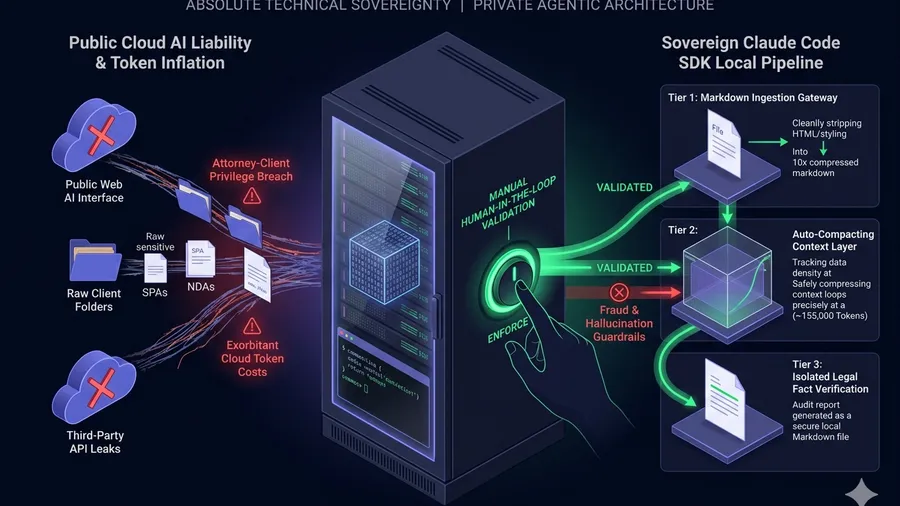
Agentic engineering reclaims total control by migrating the AI out of the browser and directly into a secure, sandboxed terminal execution tier utilizing advanced developer toolchains. By pairing a secure n8n background architecture with developer SDK implementations (such as Python/TypeScript terminal agents) and a relational database foundation like Postgres to log execution logs, code auditing transforms into a strict, token-efficient production assembly line: [Local Source Code Repos] ──► [n8n Local Terminal Agent (Markdown Fetch)] ──► [Postgres Execution Registry] │ ▼ [Airtight Git Production Push] ◄── [CTO Terminal Approval / Hook Release] ◄── [HumanLayer Intent Interceptor] According to core technical benchmarks found in Agentic workflow info source & NotebookLM Prompt for Nesthing Blog Post_29, modern terminal-centric agentic systems completely bypass HTML token bloating by executing auto-headers (such as adding Accept: "text/markdown, *" directly to requests), forcing document servers to deliver clean, highly compact Markdown payloads. This advanced design choice shrinks token usage by up to 10x, entirely eliminating the data noise that causes AI models to skip over micro-vulnerabilities.
Furthermore, instead of allowing an AI tool to autonomously edit production servers, the system leverages a strict HumanLayer abstraction design pattern combined with auto-compact context ceilings (automatically condensing context histories when approaching tight thresholds like 155k tokens to retain an optimal buffer). When a security flaw or refactoring target is isolated, the micro-agent locks the deployment loop, logs the complete execution trace directly to a Postgres relational memory stack, and surfaces an interactive auto-accept or terminal-hook prompt directly to the lead architect’s command line or secure channel. No raw code is ever transmitted to a third-party public vector space, and no file modifications occur without explicit human verification.
🛠️ Blueprint Breakdown: The 3-Tier Sovereign Engineering Automation Architecture
To allow tech startup founders, DevOps managers, and software architects to deploy this localized code governance architecture with absolute confidence, the framework is structured into three distinct operational tiers:
Node 1: Token-Optimized Markdown Ingestion & Local Context Controller
The technical input layer that strips out data waste and enforces strict token discipline across all integrated code repositories and technical documents.
- ✓ 10x Context Compression: By forcing communication channels to request and send native Markdown formats instead of bloated HTML structures, the agent slashes overhead costs and maximizes accuracy.
- ✓ Auto-Compact Buffer Guardrails: Relational tracking nodes monitor usage caps, automatically compacting historical tokens near 155k limits to guarantee an uncompromised memory buffer for long, continuous auditing operations.
Node 2: Isolated Terminal-Driven n8n Security Pipeline
The core processing layer that operates inside your private environment, executing advanced code refactoring, logic mapping, and bug scanning without leaking raw IP.
- ✓ Multi-Language SDK Integration: Leverages native Python and TypeScript engine frameworks to perform deep, programmatic scanning of multi-file directory structures directly within your isolated staging sandbox.
Node 3: Sovereign HumanLayer Codebase Release Gatekeeper
The executive authorization interface that integrates direct human gatekeeping mechanics into the automated development lifecycle.
- ✓ Auto-Accept Mode & Intercept Hooks: Developers can switch into an accelerated ‘auto-accept mode’ via toggle switches for routine non-breaking file edits while maintaining hard intercept hooks that lock the terminal when core architectural paths are modified.
- ✓ Immutable Audit Tracking: Every automated analysis, suggested modification, and human verification signature is immutably logged into a localized database registry, generating compliance-ready dev trails.
💡 Conclusion: Preserving Technical Sovereignty in the Age of Autonomous Agents
In the rapidly evolving software ecosystems of 2026 across Kuala Lumpur and Singapore, code velocity combined with uncompromised asset security is the ultimate market differentiator for tech startups. Engineering groups that continue to copy-paste corporate code secrets into unmonitored browser extensions or wide-open public AI text prompts are inviting massive IP contamination and severe regulatory backlash.
By anchoring your engineering pipeline with token-efficient n8n orchestration, local transactional tracking databases, and localized terminal agent toolchains, your company builds an unbreachable wall of technical sovereignty. You protect your core digital IP, strip out massive token over-expenditures, and give your engineering directors absolute control over every algorithmic modification. Keep your codebases secure, your context windows highly compressed, and your architectural oversight uncompromised.