· Enterprise AI · 8 min read
The Amnesiac Loop Shield: Mitigating Prompt Injections and Retainer Leaks in Corporate Law Firms via Postgres Row-Level Security
Discover how elite corporate law firms in Singapore and KL deploy multi-tenant n8n routers, Postgres Row-Level Security, and token re-billing to automate document discovery without cross-contaminating M&A retainers.
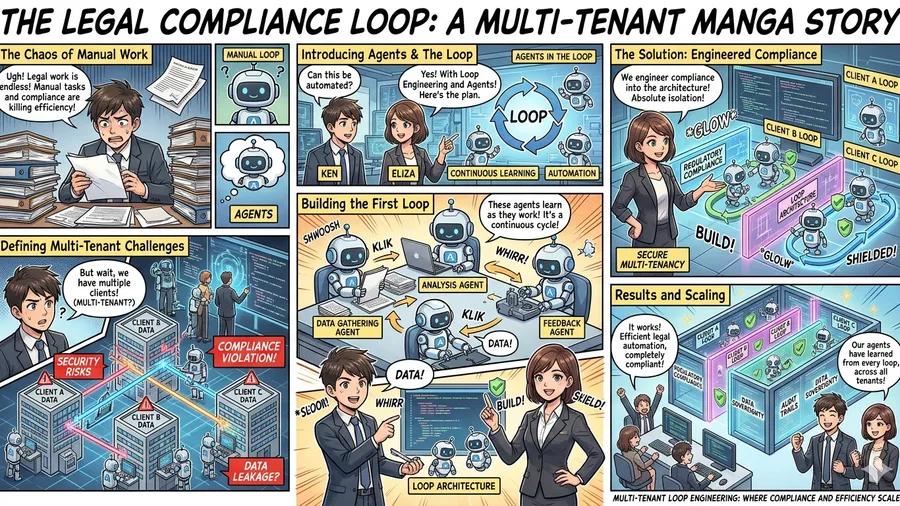
🚀 For managing partners and senior directors at top-tier corporate law firms across Singapore’s Downtown Core and Kuala Lumpur’s commercial hubs—handling complex mergers and acquisitions (M&A), cross-border restructuring, and high-stakes patent litigation—confidentiality is not merely a service standard; it is a strict regulatory mandate under the Singapore PDPA and Malaysia PDPA. As elite firms race to adopt agentic workflows to automate document discovery, review massive retainers, and cross-reference thousands of judicial precedents, they face an invisible, structural threat. Traditional legal software pipelines pass proprietary client disclosures, term sheets, and litigation strategies through unisolated LLM context windows. If an AI agent running inside an autonomous execution loop suffers a sophisticated adversarial prompt injection or code-level state misalignment, the system risks cross-contaminating files. This can accidentally expose the trade secrets or valuation metrics of one prominent corporate client to an opposing legal team, resulting in malpractice suits and devastating reputation damage overnight.
❌ Relying on flat, single-tenant commercial AI plugins or unisolated data pipelines is a catastrophic regulatory risk. When a legal automation pipeline is engineered to run iteratively over long horizons, any minor error or context leak compounds exponentially across turns. In long-running agentic applications, the cost of an architectural mistake scales directly with the number of processing turns it survives before human verification catches it. Flat-file integrations store diverse client records within shared execution boundaries, making them highly vulnerable to context-window bleeding where data from separate corporate entities mix. To eliminate data liability while deploying advanced autonomous automation, enterprise legal groups must align with the architectural standards detailed in our cornerstone framework: 2026 Malaysia & Singapore High-Net-Worth Industry AI Agent Deployment Whitepaper.
💡 The gold standard for secure legal automation is Loop Engineering decoupled through an n8n Multi-Tenant Routing Architecture, backed by Postgres Row-Level Security (RLS) Policies and Scoped API Key Escrow. Rather than deploying a costly, fragmented web of isolated AI software instances for every individual corporate account or active case file, a single, central n8n HTTP router node dynamically adapts its authorization scope based on cryptographic tenant signatures. Every automated cycle is continuously monitored and logged via a dedicated Decision_Audit_Gateway, instantly transforming massive backend LLM API overhead into a highly transparent, case-level billable asset that drives direct profit back to the firm.
🛠️ Tech Synthesis: Context Extinction vs. Scoped, Amnesiac Loop Architectures
Standard AI systems process multiple client inputs within a single, flat workspace database cluster, relying on basic software application filters to hide data between unrelated cases. If an adversary triggers a prompt injection or a complex recursive loophole occurs, the flat data architecture allows the model to access adjacent rows, exposing unauthorized legal dossiers.
Our Scoped API Credential Escrow methodology completely eliminates this vulnerability by separating the architecture into three isolated execution layers as outlined in the Agentic workflow info source & NotebookLM Prompt for Nesthing Blog Post_42 structural framework: [Incoming Discovery Stream] ──► [n8n Multi-Tenant Router] ──► [Postgres Row-Level Security] │ ▼ [Case-Level Billable Ledger] ◄── [Decision_Audit_Gateway] ◄── [Transient Scoped API Tokens] When an autonomous legal agent initiates a long-running discovery task, the n8n multi-tenant router queries a localized Postgres Policy Registry. Instead of processing raw files within a persistent, vulnerable memory loop, the system enforces strict Postgres Row-Level Security (RLS) constraints mapped to that specific corporate client ID. The system dynamically provisions short-lived, read-only Scoped API tokens bound exclusively to that single transaction, matching the essential Harness Engineering paradigm.
Furthermore, to prevent the dreaded Amnesiac Loop error—where a loop discovers high-value work, executes it, but immediately forgets it occurred because the results lived only in a temporary context window that was flushed—the system forces the agent to persist its current state file safely onto an isolated disk repository rather than within the volatile LLM window. The next morning, the agent checks the repository state to ensure it never rediscovers or redoes the same work. Once the review turn finishes, the ephemeral token is instantly destroyed, ensuring no persistent attack vector remains.
🛠️ Blueprint Breakdown: The 3-Tier Enterprise Legal AI Architecture
To allow managing partners and legal compliance officers to maintain strict oversight without managing complex programming environments, our deployment blueprint is divided into three clear operational tiers:
Node 1: n8n Dynamic Multi-Tenant Stream Router
The centralized security core that ingests, sanitizes, and isolates all incoming contracts, corporate structures, and trial evidence streams at the initial network handshake.
- ✓ Case and Retainer Isolation: Manages hundreds of separate corporate accounts simultaneously within a single master node, segregating individual M&A files instantly based on secure client signatures.
- ✓ Ephemeral Token Generation: Micro-provisions short-lived, read-only diagnostic keys that expire automatically upon task completion, meeting the strictest regulatory standards for corporate data privacy.
- ✓ Deterministic Loop Gates: Prevents agents from running infinitely or spinning out of control by enforcing strict internal budget caps and automated scheduling rules, maintaining structural predictability.
Node 2: Postgres Row-Level Security & Independent Verification Engine
The cryptographic database foundation that ensures unrelated corporate retainers never intersect within the agent’s active execution window.
- ✓ Row-Level Access Enforcement: Restricts access directly at the database engine level, blocking lateral data exploration even if an incoming document contains a malicious prompt injection payload designed to bypass software-level filters.
- ✓ Independent Dual-Agent Verification: Utilizes a strict Generator/Evaluator split. A secondary, highly restricted Reviewer Agent audits the main processing agent’s output against pre-configured legal compliance boundaries before any report lands in the human queue.
- ✓ Zero-Retention Execution: Guarantees that sensitive corporate trade secrets, patent descriptions, and personal data remain stored within your local on-premise or secure private cloud environments, never leaking into external training datasets.
Node 3: Decision_Audit_Gateway & Case-Level Re-billing Dashboard
The financial command center that transforms complex technical computing overhead into a highly accurate, audited billable revenue stream for the firm.
- ✓ Granular Token Allocation: Monitored via the
Decision_Audit_Gateway, every individual API prompt call, vector search, and automated page audit is logged down to the exact millicent. - ✓ Automated Case-Level Invoicing: Pairs token consumption metrics directly with internal matter codes, compiling clear, audit-ready monthly asset reports for partners and clients.
- ✓ Premium Technology Markup: Packages the raw computational tracking data into a premium service category. This allows law firms to re-bill LLM processing expenses back to corporate retainers with a 200% to 300% markup as a specialized “Automated Real-Time AI Document Discovery & Verification” line item, converting IT operational costs into a high-margin profit center.
💡 Conclusion: Uncompromising Data Sovereignty for High-Stakes Legal Operations
In the elite corporate legal sectors of Singapore and Kuala Lumpur, data privacy is your core asset. As long-running agentic workflows shift from an operational experiment into a foundational competitive necessity, the firms that dominate the market will be those that prioritize data isolation and deterministic guardrails over simple, off-the-shelf software solutions.
By implementing an enterprise-grade architecture built on n8n multi-tenant routing, Postgres row-level security, and a revenue-generating Decision_Audit_Gateway, you build an impenetrable barrier around your legal workflows. You deliver rapid, highly accurate, and continuous document analysis for your high-value corporate accounts while transforming standard cloud infrastructure expenses into a premium, highly profitable billable asset engine. Secure your firm’s technological sovereignty today.