· Enterprise AI · 6 min read
Zero-Leak Intelligence: Implementing Local Private AI for Secure Corporate Document Analysis under PDPA 2024
Discover how enterprises in Kuala Lumpur and Singapore deploy localized n8n pipelines and private LLM nodes to analyze confidential corporate PDFs and financial records without triggering public data leaks or violating the Personal Data Protection (Amendment) Act 2024.
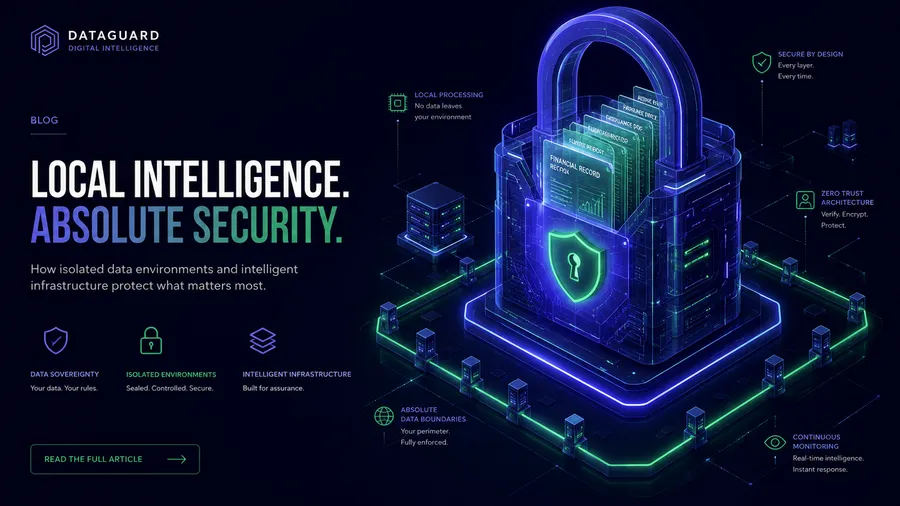
🚀 For managing directors, chief financial officers, and corporate legal counsels across Kuala Lumpur and Singapore, extracting immediate insights from dense corporate text remains an operational bottleneck. Every single day, executive teams handle sensitive commercial instruments, asset audits, tax optimization files, and cross-border merger frameworks. Blindly uploading these highly proprietary corporate PDFs into public cloud-hosted AI models introduces massive data vulnerabilities and exposes organizations to extreme liability.
❌ Shifting data outside the physical boundaries of the corporate infrastructure introduces unacceptable risk. Under the strict revisions of the Personal Data Protection (Amendment) Act 2024, the processing of personal data in commercial transactions by Data Users is heavily regulated to protect the fundamental privacy interests of Data Subjects. Passing internal employee records, payroll structures, or proprietary client transactions through public cloud-hosted API training pipelines is a direct violation of statutory compliance, threatening massive corporate fines and severe brand damage. To understand how regional leaders orchestrate data sovereignty and automated growth across private networks, review our master blueprint: 2026 Malaysia & Singapore High-Net-Worth Industry AI Agent Deployment Whitepaper.
💡 The modern enterprise solution requires shifting from open internet API endpoints to fully localized, self-hosted document processing architectures. By anchoring open-source models inside secure on-premise workflow pipelines, mid-market enterprises can summarize corporate PDFs securely without any data leaks while conducting deep private financial document analysis at a minimal cost.
🛠️ Tech Synthesis: Public Cloud Leaks vs. On-Premise Private AI Architectures
Standard cloud-based language models use inbound user prompts and document attachments to train future public model iterations, making it highly probable that your confidential financial KPIs or proprietary corporate data templates could be exposed to competitor queries.
According to the specialized technical telemetry detailed in “Agentic workflow info source & NotebookLM Prompt for Nesthing Blog Post_18”:
The technological landscape has shifted from fragile cloud dependencies to robust, 100% private execution models. Leveraging foundational architectures like privateGPT allows corporate systems to interact with sensitive internal documents using the power of generative text models entirely locally. By integrating open-source engines like Ollama to run lightweight models such as Llama3.2 directly within a private network ecosystem, enterprises can process private document analysis, execute local AI templates like a Tax Code Assistant, and build intelligent workflows completely offline.
By combining an enterprise pipeline manager like n8n with an isolated local hardware stack, corporate teams can deploy an Air-Gapped Document Intelligence Agent that processes records entirely on local bare-metal servers: [Confidential Corporate PDF] ──► [n8n Local Ingestion Node] ──► [Local PDF Parsing Framework] │ ▼ [Secure Structured Insight] ◄── [Private Vector Store] ◄── [Ollama Local Llama3.2 Node] When an executive drops an unencrypted financial file or legal contract into the secure local ingestion directory, an n8n workflow intercepts the file locally. The document is parsed and vectorized entirely within the internal network perimeter using a local vector store. The local intelligence layer—powered by Ollama executing a localized Llama3.2 instance—reads the structured chunks to extract liabilities, perform risk modeling, or execute financial audits without a single data packet ever leaving the physical company premises.
🛠️ Blueprint Breakdown: The 3-Tier Private Analytics Architecture
To enable corporate technology officers, internal auditors, and operations leads to rapidly deploy this framework, the architecture is divided into three distinct localized tiers:
Node 1: Secure Local Ingestion & Parsing Tier
The workflow monitors private network shared drives or secure enterprise storage instances via local n8n container integration hooks.
- ✓ Physical Containment: Text extraction, file decompression, and formatting operations occur completely within your isolated corporate network, entirely removing internet vulnerabilities from the data-ingestion phase.
Node 2: Local Vectorization & Local Model Execution Tier
The parsed textual data is converted into vector representations and queried against a localized model database instance.
- ✓ 100% Data Sovereignty: By utilizing Ollama to host Llama3.2 locally, the system performs complex semantic question-answering and comprehensive metadata filtering entirely offline. No data parameters are sent to external entities, guaranteeing perfect alignment with the data processing limits mandated by the PDPA 2024 framework.
Node 3: Private Corporate Analytics & Reporting Tier
The localized agent maps out precise textual evidence, matches sections to regulatory compliance rules, and formats structured summaries.
- ✓ High Factual Density: The agent creates crisp financial summaries, outlines audit discrepancies, and constructs compliance checklists. The resulting outputs are written back directly into private local databases or pushed to internal communication tools like a secured local Slack bot instance.
💡 Conclusion: Achieving Strategic Growth through Sovereign AI Architecture
In the 2026 enterprise landscape, scaling operational capability requires maintaining strict data compliance. Mid-market businesses cannot afford to choose between AI efficiency and data privacy. Those who continue to feed sensitive corporate records into public models risk regulatory penalties under the PDPA 2024 framework.
Deploying an autonomous, on-premise document processing system via n8n and Ollama solves this dilemma. It provides your executive team with high-speed intelligence while building a defensive wall around your proprietary enterprise data assets. By owning your infrastructure and running private models locally, you insulate your company from compliance risks while establishing an elite corporate operations engine designed for long-term growth.