· Enterprise AI · 8 min read
The Death of Unbillable AI Overhead: How KL Law Firms Turn n8n Multi-Tenant Routing into a 300% Token Profit Center
Discover how elite law firms in Kuala Lumpur leverage n8n multi-tenant workflows and Decision Audit Gateways to securely automate client file analytics under PDPA while re-billing AI compute at a premium.
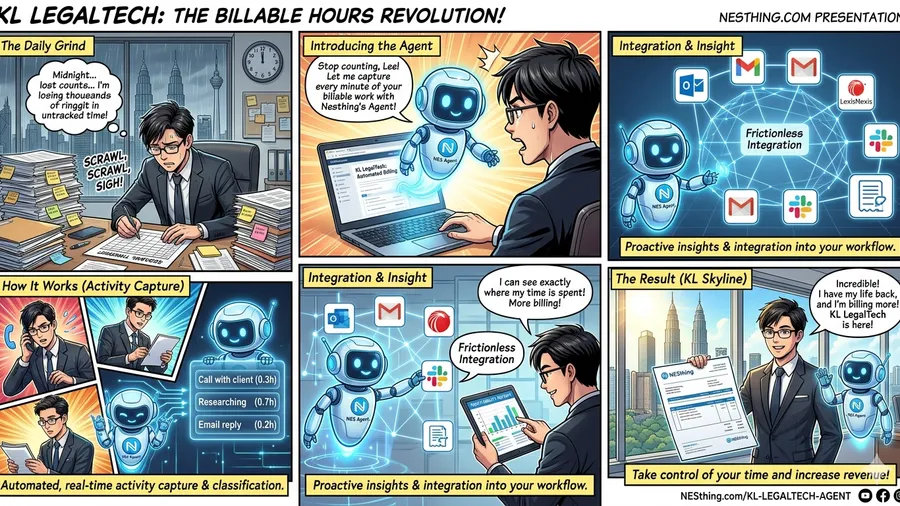
🚀 For managing partners, senior counsels, and elite boutique law firms operating across Kuala Lumpur—from the corporate high-rises of KLCC to the prestigious legal chambers in Mont Kiara—the modern billable hour is undergoing an unprecedented structural disruption. In highly competitive practice areas such as corporate mergers & acquisitions, cross-border commercial litigation, and high-net-worth estate disputes, junior associates spend countless unbillable hours manually parsing discovery documents, extracting clauses, and cross-referencing statutory precedents. While deploying autonomous AI agents to handle document analysis seems like an obvious solution to recover lost operational capacity, generic implementation introduces catastrophic risks. Under the strict statutory frameworks enforced by the Bar Council Malaysia and the Personal Data Protection Act (PDPA), streaming unvetted corporate portfolios or sensitive client records through standard cloud software creates an immediate exposure vector for data leaks, potentially violating attorney-client privilege.
❌ Relying on flat, single-tenant commercial AI integrations or raw, shared API keys across multiple active litigation files is a structural liability. In typical AI setups, every case profile and client record is fed through a unified workspace memory buffer. For long-running autonomous workflows that cycle through recursively generated tasks, any unexpected context-window drift or adversarial prompt injection can cause metadata to bleed across client boundaries—accidentally exposing confidential corporate buyout terms during a completely unrelated asset audit. Furthermore, law firms traditionally absorb the resulting LLM token costs as flat, unrecoverable IT overhead, unable to accurately attribute precise compute consumption to specific client files. To deploy automated legal reasoning safely without cross-contaminating highly sensitive files, premier partnerships must align with the security blueprints detailed in our comprehensive roadmap: 2026 Malaysia & Singapore High-Net-Worth Industry AI Agent Deployment Whitepaper.
💡 The industrial-grade solution to this architectural bottleneck is Loop Engineering decoupled through an n8n Multi-Tenant Routing Architecture, backed by Postgres Row-Level Security (RLS) Policies and a specialized Decision_Audit_Gateway. As modeled on the advanced data isolation principles detailed in Agentic workflow info source & NotebookLM Prompt for Nesthing Blog Post_45, this setup strictly decouples the LLM processing runtime from permanent storage paths. Instead of licensing expensive, separate software instances for every individual practice group, a single, central n8n workflow routing node executes the entire firm’s automation workloads. Concurrently, the architecture intercepts every execution cycle, immediately converting abstract infrastructure processing costs into an audit-ready, high-margin billable asset.
🛠️ Tech Synthesis: The Leak-Prone Shared Workspace vs. Decoupled Loop Engineering
Traditional legal document applications embed integration credentials directly within the core runtime script, making it impossible to adjust access permissions dynamically when switching between different case files. If an automation script scans a massive multi-volume discovery file, a single system failure can lock the runtime loop, causing the agent to cross data boundaries and query unauthorized databases.
Our Scoped API Credential Escrow framework eliminates this vulnerability by completely dividing the environment into distinct layers: Context Engineering, Harness Engineering, and Loop Engineering. Rather than granting the core AI orchestrator permanent administrative access to the firm’s entire document repository, access permissions are micro-provisioned dynamically on a per-task basis. [Incoming Legal PDF File] ──► [Central n8n Multi-Tenant Router] ──► [Postgres Row-Level Security] │ ▼ [Case-Level Invoice Asset] ◄── [Decision_Audit_Gateway] ◄── [Transient Scoped API Tokens Escrowed] When an autonomous agent initiates a document-drafting or clause-auditing sequence, the central n8n node catches the request and validates the specific case file’s tenant signature. The platform checks an isolated Postgres Policy Registry and dynamically provisions a short-lived, read-only Scoped API token limited exclusively to that single client row or file directory.
Furthermore, to guarantee absolute analytical precision, the architecture incorporates a rigorous safety mechanism: Growing the Loop Safely. Instead of scaling parallel workflows unchecked, the system maintains strict control via deterministic gates. A secondary Independent Evaluator agent automatically stress-tests the primary Generator agent’s contractual extractions against explicit legal criteria. The system treats all processing outputs as unverified until verified by the evaluator gate, ensuring no corrupted interpretations slip into active litigation bundles. Once the analysis concludes, the transient token is instantly deleted, neutralizing any possibility of lateral data leakage.
🛠️ Blueprint Breakdown: The 3-Tier Sovereign Legal Automation Architecture
To allow managing partners and legal operational directors to maintain ironclad governance over automated workflows without reading complex code, the platform is divided into three functional tiers:
Node 1: n8n Dynamic Multi-Tenant Stream Router
The central gateway that classifies, cleanses, and partitions all incoming corporate briefs, case disclosures, and litigation files at the initial network handshake.
- ✓ Practice Group Data Isolation: Coordinates multiple separate practice groups within a single master node, segregating active case files instantly based on cryptographic enterprise signatures.
- ✓ Amnesiac Scope Verification: Dynamically provisions read-only, short-lived database access keys that automatically self-destruct upon task completion, ensuring total compliance with PDPA guidelines.
- ✓ Deterministic Loop Control: Prevents long-running document analysis tasks from running into endless execution cycles by enforcing strict processing time limits and automated batch scheduling.
Node 2: Postgres Row-Level Security & Adversarial Validation Engine
The cryptographic database layer that guarantees separate corporate files and client histories never intersect within the agent’s active execution window.
- ✓ Engine-Level Access Isolation: Enforces data boundaries directly within the core database schema, blocking data visibility across client files even if an analyzed document contains an adversarial prompt injection designed to bypass software filters.
- ✓ Adversarial Dual-Agent Validation: Utilizes a dual-agent structure modeled on the safety protocols of Agentic workflow info source & NotebookLM Prompt for Nesthing Blog Post_45. A secondary Reviewer Agent cross-checks all extracted contractual findings before they are pushed to the attorney’s desk.
- ✓ State-Driven Progress Retention: Records the agent’s analytical progress to a secure local disk file after each turn, enabling the system to resume immediately without duplicating work or doubling token costs if an external connection drops.
Node 3: Decision_Audit_Gateway & Case-Level Re-billing Ledger
The financial dashboard that captures real-time computational token overhead and transforms it into an optimized profit center for the firm.
- ✓ Granular Token Performance Auditing: Monitored via the
Decision_Audit_Gateway, every individual API call, vector database query, and summary generation is tracked down to the exact millicent. - ✓ Case-Level Asset Reporting: Pairs token consumption metrics directly with localized client billing codes, generating transparent, audit-ready monthly resource logs.
- ✓ Disbursement Premium Markup: Packages raw computing data into a high-margin internal asset. This allows law firms to re-bill processing costs back to client disbursements with a 200% to 300% premium markup as a specialized “Automated Structural Document Audit & Pre-Discovery Analysis” service, transforming an IT expense into a direct revenue driver.
💡 Conclusion: Securing Legal Sovereignty in Premium Practice Groups
In Kuala Lumpur’s elite corporate legal sectors, maintaining data security is the foundation of reputational value. As long-running agentic workflows shift from a premium advantage to a standard operational requirement, the law firms that lead the market will be those that isolate their internal workflows with strict data separation and deterministic guardrails.
By deploying an enterprise architecture built on n8n multi-tenant routing, Postgres row-level security, and a revenue-generating Decision_Audit_Gateway, you build a fortress around your client data. You deliver rapid case-file analysis across all practice groups while converting technical cloud overhead into an optimized, high-margin profit center. Secure your firm’s technological sovereignty today.